: A publication of Jesuit Communications Australia
Podcasts (all articles)  |  Join us on Facebook   |  Follow us on Twitter
EUREKA STREET  
Search our site
You can search by topic, author, article title and keywords.


Advertisement


Advertisement

Advertisement

1pix
smaller font larger font print article Email this Article to a Friend Bookmark and Share
Home ยป Eureka Street Extra > Relic rumination
THE MEDDLING PRIEST

Relic rumination

Frank Brennan September 26, 2012

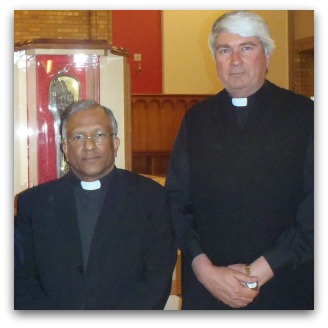
Cathedral Administrator, Fr Francis Xavier Kolencherry and Fr Frank Brennan SJ with the relicAt the outset, let me apologise for the absence of the intended homilist, Fr Des Purcell SJ. Like St Francis Xavier, Des is a Jesuit who served for some years as a missionary in India. Unfortunately, he is ill this evening. Being the Jesuit superior here in Canberra, I am the substitute. Xavier was no stranger to being substitute, but more of that anon.

We gather to reverence and pray before the arm of Francis Xavier. Over the years, many of us have had the opportunity to kneel before this arm at the side altar in the Gesu Church in Rome, opposite the altar dedicated to Ignatius Loyola.

But its presence here in Australia confronts us with challenges, as well as opportunities. We 21st century Australians are not altogether at home with relics here in our own modern churches. But then again memorabilia are not completely foreign to our western modern mindset.

Whenever the US President signs into law a new piece of legislation which is said to be emblematic of his presidency, he invites a group of key supporters to the Oval Office for the signing and then presents the signing pen to someone who campaigned strongly for the cause of the legislation. We have much more than a pen here.

Even here in Australia, we delight in some memorabilia. Just on Monday, the media informed us that 'Jeff Thomson is selling the prized baggy green cap he wore when skittling the Poms 30 years ago during a vintage fast-bowling summer'. Even sports mad Aussies have some sense of the sacred.

Here 460 years after his death, we are gathering before the arm of Francis Xavier who baptised tens of thousands of people in India and Japan, and who died aged just 46 while awaiting his entry to China.

Hailing from Navarre in Spain, he came to the University of Paris, a keen student, an accomplished athlete, focused on worldly achievements. He shared digs with Peter Favre. They then took in the older Inigo from Loyola who wanted to introduce them to his Spiritual Exercises. Favre was very accommodating; Xavier less so.

It was not until Favre went home to visit his family in 1533 that Ignatius had the chance to draw Francis into his spiritual web.

Seven years later, the Society of Jesus was formed and Ignatius responded to a call from the Pope who was being pressured by the King of Portugal to send missionaries to the Portuguese possessions in India. Ignatius chose two others of his companions, but when one fell ill at the last minute, he chose Francis as the substitute.

Thus commenced the most concerted 12-year missionary effort by any man in history — from India, through South East Asia to Japan and on to the gateway to China. Our own Cathedral Administrator, Fr Francis Xavier Kolencherry, traces his family faith journey back to his home village which Francis Xavier visited more than 450 years ago. On 15 January 1544, Francis wrote to Ignatius with great passion saying:

Multitudes out here fail to become Christians only because there is nobody prepared to undertake the holy task of instructing them.

I have often felt strongly moved to go to the universities of Europe, especially Paris, crying out like a madman, and say to those in the Sorbonne who have more learning than good will to employ it advantageously: 'How many souls are missing heaven and going to hell through your negligence?'

If only, while they studied their humanities, they would also study the account that God will demand for the talent he has given them, many might feel the need to engage in spiritual exercises, so as to discover God's will in their hearts and to embrace it rather than their own inclinations, saying: 'Lord, here I am. What would you have me to do? Send me where you will, if necessary even to India.'

What are we to make of this exclusive missionary passion today — a passion almost posited on the notion of no salvation outside the Church? We are now more open to other faiths and cultures. We find guidance and adaptation in the recent injunctions of Popes when speaking to contemporary Jesuits. Four years ago, Pope Benedict XVI said to us Jesuits:

At a time when new geographical horizons were being opened, Ignatius' first companions placed themselves at the Pope's disposal 'so that he might use them where he judged it would be for God's greater glory and the good of souls' (Autobiography, n. 85).

They were thus sent to announce the Lord to peoples and cultures that did not know him as yet. They did so with a courage and zeal that still remain as an example and inspiration: the name of St Francis Xavier is the most famous of all, but how many others could be mentioned!

Earlier, Benedict recalled the words of his predecessor Paul VI who said on the Feast of Francis Xavier 1974:

Wherever in the Church, even in the most difficult and exposed fields, in the crossroads of ideologies, in the social trenches, there has been or is confrontation between the burning exigencies of humanity and the perennial message of the Gospel, there have been and are the Jesuits' (3 December 1974, to the 32nd General Congregation).

For his part, Benedict spelt out the modern equivalent of going to the pagans in faraway India. He told us:

Nowadays the new peoples who do not know the Lord or know him badly, so that they do not recognise him as the Saviour, are far away not so much from the geographical point of view as from the cultural one. The obstacles challenging the evangelisers are not so much the seas or the long distances as the frontiers that, due to a mistaken or superficial vision of God and of man, are raised between faith and human knowledge, faith and modern science, faith and the fight for justice.

As we contemplate and reverence this relic tonight, we commit ourselves afresh to go to the frontiers, crossing the bridges of cultural and religious divides, and travelling into the often unmapped territory between faith and human knowledge, between faith and modern science, and between faith and the fight for justice.

Moving from physical boundaries and frontiers to existential and spiritual boundaries and frontiers, we do not stay focused on a moribund, severed arm. Rather we remember that Francis with this arm always pointed towards Christ, and always embraced all before him, especially the poorest of the poor.

We pray that like Francis we might fight the good fight, finish the race and keep the faith. (2 Tim 4:6-8) In these challenging times for our Church, lets recall that when the Counter-Reformation was celebrated with the canonisation of four saints in 1622, their number did not include any popes, cardinals or bishops. Teresa of Avila, Philip Neri, Ignatius Loyola and Francis Xavier led the Church through prayer and service.

We pray for the grace to respond accordingly to the great challenges confronting us in the world and within our suffering Church.

Frank Brennan headshotFr Frank Brennan SJ is professor of law at the Public Policy Institute, Australian Catholic University and adjunct professor at the College of Law and the National Centre for Indigenous Studies, Australian National University. The above text is from his address at St Christopher's Cathedral, Canberra, for the Visit of the Relic of St Francis Xavier, 26 September 2012. Photo: Cathedral Administrator, Fr Francis Xavier Kolencherry and Fr Frank Brennan SJ with the relic (top left)


Bookmark and Share

Enjoyed this article? To ensure that Eureka Street can continue its 20 year publishing tradition, click here to make a donation to Eureka Street.

To email to a friend, click here.


COMMENT ON THIS ARTICLE


Submitted feedback is moderated. Email is requested for identification purposes only.

Name:
Email:
Comments:
Word Count: 0
(please limit to 200)


SUBMITTED COMMENTS


Father John Michael George27 Sep 2012

As an incessant critic of frequent unorthodoxies within ES, I am at last most edified by an article, by a Jesuit, here extolling veneration of the relics, of the courageous apostolic Jesuit St Francis Xavier.
St Ignatius would be truly proud at adherence to his , "Sentire cum Ecclesia" rules for Jesuits:
"6. To praise relics, the veneration and invocation of Saints: also the stations, and pious pilgrimages, indulgences, jubilees, the custom of lighting candles in the churches, and other such aids to piety and devotion."
Well done Father Brennan SJ


L Newington2bigpond.com27 Sep 2012

With all due respect to everybody, St Francis Xavier, I wonder what St Francis Xavier would really think of his arm being detatched from his body, and put on public display.

Not to mention poor St Anthony's tongue.
With the thousands of skeletons held sacred throughout Catholic Christendom, has it made any difference in reminding one of their own mortality, considering.......


Tony Robertson03 Oct 2012

I often wonder why Catholic saints never seem to have RIP appended to their titles as we do to other mere mortals who have died. Perhaps it has something to do with the process of canonisation which usually involves the exhuming of the remains and then, if bits can be found, relocating them in elaborate mausoleums or if fully intact, a glass case for viewing. Whatever, it seems that these heroes of the faith are never allowed to rest in peace. The Land Downunder is now hosting Francis Xavier We don't get all his bits, just his right arm. Most of his bits were on public display in Goa in 2004-2005. The right arm has been dislocated from the rest of his body as a religious act of reverence for his ability to bless and baptise. One wonders if the same effect would be gained had the poor man been left handed?


Paul03 Oct 2012

There is a difference between Jeff Thompson's baggy green and his bowling arm.


L Newington03 Oct 2012

I may have expressed my views re-this relic,but wouldn't joke about it.
It belongs to the family of Jesuits, the same as a lock of hair of a love one, it's personal.
Bad taste to say the least.


Previous Articles by this Author

THE MEDDLING PRIEST

Church and ordained ministry in the 21st century  

Fr Frank Brennan's keynote address at the Archdiocese of Canberra and Goulburn Clergy Assembly, St Clement's, Gaylong, on 22 May 2013


THE MEDDLING PRIEST

Time to draw the line between Australia and Timor Leste  

East Timor flagAustralian governments of both political persuasions have reassured the Australian public that they are decent and special when it comes to dealing with the Timorese over disagreements in the Timor Sea. Time for such special pleading is over. For the good of ongoing relations between these two unequal neighbours, it is time for Australia to commit to negotiating final maritime boundaries.


THE MEDDLING PRIEST

Malaysia Solution is dead in the water  

Little girl in pink T-shirt crouches near blue UNHCR backbacks

It is time for each side of politics to stop blaming the other for the increasing wave of boats and for Gillard to cease invoking the unreal prospect of a revised Malaysia Solution. A revised arrangement consistent with the recommendations of the Expert Panel is an impossibility before the election.


THE MEDDLING PRIEST

Abbott's quest for constitutional inclusion  

Map of Australia made up of faces from different culturesGiven the opinion polls and divisions in Labor, it's no surprise Abbott is confidently preparing his team for government. Anything he says about constitutional change therefore carries weight. Advocates for constitutional recognition of Indigenous Australians would be heartened then by two of his recent speeches. 


THE MEDDLING PRIEST

Rudd right not to run  

Some lamented that Rudd had abandoned his own supporters to their fate. But what political morality would dictate that he break his word simply because Crean had decided an immediate challenge was the only available circuit breaker for the woes of a dysfunctional divided Labor Party?


THE MEDDLING PRIEST

University as an agent of transformation  

'Transformation and empowerment will come through the exercise of kindness and tenderness, accompanied by the practical abilities inculcated by a rounded Catholic education.' Frank Brennan's address at the Transformation and Empowerment Symposium marking 50 years of the Signadou campus of ACU, 22 March 2013.


THE MEDDLING PRIEST

Recognising Aboriginal and Torres Strait Islander People in the Constitution  

Frank Brennan's address 'Recognising Aboriginal and Torres Strait Islander People in the Constitution' presented at the 18th National Schools Constitutional Convention, The Museum of Australian Democracy at Old Parliament House, 21 March 2013.


THE MEDDLING PRIEST

How can the Catholic Church contribute to a better culture for life?  

Change is upon the Church. Just recall the scene when the new pope emerged on the Vatican balcony. He appeared with none of the papal trimmings of office, and did not once did he refer to the papacy. Could something of this new papal style help Catholics engage more creatively with their fellow citizens? Text from Frank Brennan's lecture 'How Can the Catholic Church Contribute to a Better Culture for Life?'


THE MEDDLING PRIEST

Church blame in the frame  

Religious icon weeping bloodThere is a temptation to see justice, compassion and transparency as the obsessive concern of western liberals. They are much more universal than that; they are the contemporary, institutional rendition of gospel values. The unaccountable hiddenness of Vatican clericalism has reached its use-by date.


THE MEDDLING PRIEST

Inspirational Abbott's Indigenous aspiration  

Eddie MaboLet's not underestimate the significance of John Howard's successor giving credit to Paul Keating for his Redfern speech, before invoking New Zealand's Treaty of Waitangi and calling for atonement. Still there is plenty of work to be done to attain proper constitutional recognition of Indigenous Australians.


More from this section


Law and justice for abuse victims, Indigenous Australians and asylum seekers
Frank Brennan 31-Oct-2012

'Even without the political static which is drowning us all out down there in Canberra, there is real doubt whether the Gillard bluff 'Don't get on a boat because you might end up in Nauru' can do what the Howard bluff could not deliver.' Full text from Fr Frank Brennan SJ's Law and Justice Oration at the Law and Justice Foundation 2012 Justice Awards Dinner, Parliament House, Sydney.


Read more


Brennan and Katter's Aboriginal pilgrimage
Frank Brennan 30-Sep-2012

'I had the pleasure of the company of Bob Katter at a series of meetings with Aboriginal Councillors before addressing a public meeting on Palm Island. Some say there has been little growth or change on these remote Aboriginal communities. In fact some of what we saw was unimaginable 30 years ago. 


Read more
1 comment(s) about this article.


Working out what white Australia wants
Frank Brennan 29-Jan-2012

Gillard and bodyguardI have been feeling sad and confused about the happenings in Canberra since Australia Day. On Saturday I got on my bike and went down to the lawn of Old Parliament House. I passed a sign: 'You are now entering or leaving the Australian Aboriginal Tent Embassy ... Abusive behaviour will not be tolerated.'


Read more
10 comment(s) about this article.


Faith and famine: The new Irish who call Australia home
Frank Brennan 29-Aug-2011

Irish Famine MonumentThe faith of the Irish in politics, economics and religion is at a low ebb, and for the most understandable of reasons.  It is not a famine, but it is mighty grim. There are tens of thousands coming here under the  457 visa and the Irish Working Holiday Visa.


Read more
2 comment(s) about this article.


Mabo 20 years on
Frank Brennan 28-Oct-2012

'Though land rights and self-determination provide no utopia for the contemporary indigenous Australian community, they have belatedly put right an ancient wrong. The cost and inconvenience are unavoidable. Terra nullius is no longer an option.' Full text is from Fr Frank Brennan's keynote speech at the Central Queensland Law Association Conference, Mercure Capricorn Resort, Yeppoon, 27 October 2012.


Read more